View Full Transcript
Episode Transcript
The Story of BS
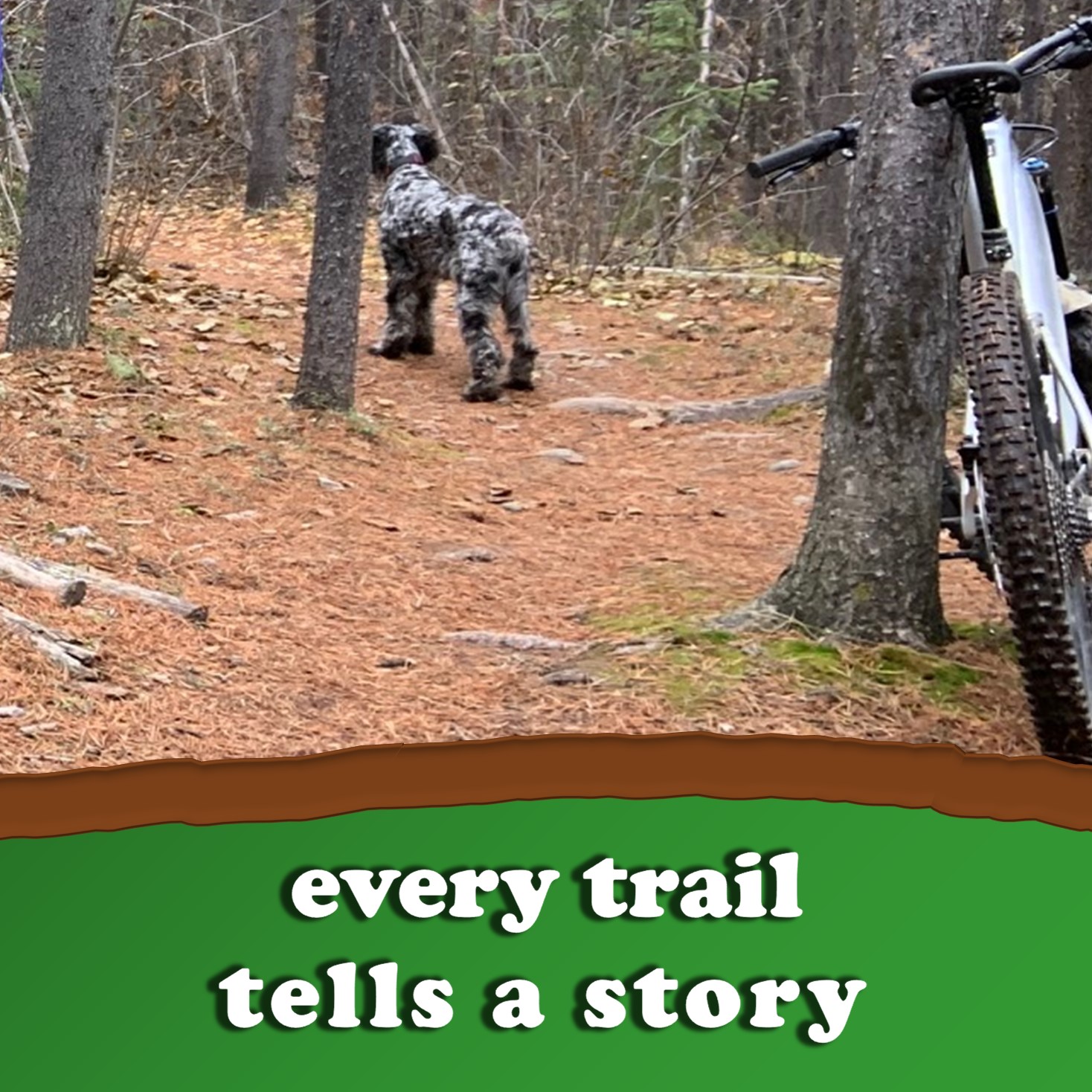
[00:00:05] TYLER COGHILL: The re-route's in now and I've only ever really ridden that once or twice. So, we had to go hunt for the old trail. Mother Nature's reclaiming it pretty quick. The kinnikinnick’s covering sections of the trail and we had to really hunt around and find where that old line even was.
My name is Tyler Coghill.
We are on a trail called B and S, in my memory, but apparently it's BS. We're at a spot where the original high peaky skinny used to be.
This trail has a ton of significance for me. I was just sitting here thinking about it. It's 26 years or so since I found this trail. I was just out here riding around and exploring and I found this trail by accident. I had no idea it existed. And I came down the steeps and I was just blown away by the trail. And then I came down to this woodwork and I was just like, “Holy crap.” I'd never seen anything like it. I was like, “Who built this? Who rides this stuff? This is wild. I'll never do anything like this.”
And as I sat there and I scoped it out and I looked at it, this group came through, Jim Coates and crew, and they were on pretty crazy-looking bikes and they were filming. They had pads on and they just rode it right in front of me. I was like, “Oh my God.” And they were like, “You should try it.” And. And I was like, “What?” Couldn't even imagine myself trying it before they showed up. And then I was watching them, I was like, okay, this is a doable thing. And the one guy was like, “Just try it. Just go for it.” And I backed up and I pedaled in and I just probably blacked out. I know my heart was racing. And I went into it and it was kind of a… you had to make it kind of thing. There weren't a lot of easy outs on that. And I somehow made it up and over. And the down had, like, gaps in the wood that would almost swallow your whole wheel. You were basically just bouncing down the down on a skinny and then you had to line up onto the last skinny and then it had a drop off the end that you had to pedal. And I have no idea how, but I cleaned the whole thing. And I was absolutely hooked at that point.
For me, this was the trail
[00:02:12] HOST: You're listening to Every Trail Tells a Story.
In this podcast, we explore the origins of our favorite Yukon trails, guided by the dreamers, planners, bushwhackers, builders, obsessive personalities… and yes, the rogues who brought these trails to life.
In this episode, builders Brad Roberts and Sean Sheardown give us the skinny on one of the earliest efforts to bring North Shore riding to Whitehorse.
This is the story of BS (not B and S!)
[00:03:16] SEAN SHEARDOWN: SB is kind of meaningless, but BS, you know, still puts a smile on my face to this day…. They put signage up, and somehow in the transition to signage, it became B and S instead of BS. Everyone thinks it's B and S because it's Brad and Sean.
[00:03:31] BRAD ROBERTS: Having Sean go first? No, that doesn't bug me at all. Sean's always had, like, a hell of a good memory on these things. I don't remember anything. Come on, dig deep. Dig deep in the brain.
[00:03:43] SEAN: I think I narrowed it down to somewhere, like, in the late 90s when BS was built.
[00:03:48] BRAD: It would probably be the 90s. Early, early 90s.
[00:03:51] SEAN: My timeline's all off on this one. I'm all over the place.
[00:03:54] BRAD: It's 30, 30 plus years now, so time is a little fuzzy.
[00:04:02] SEAN: My name is Sean Sheardown. I'm Southern Tutchone, member of Champagne and Aishihik First Nations, and I'm from the Crow clan from Hutshi, born and bred in Whitehorse.
I think I was one of the first people in Whitehorse to start mountain biking, either first year high school or last year or two of junior high.
My mom's boyfriend had gone on a trip down to California, and there's this new fad down there in the 80s called mountain bikes, and he brought one back with him. And I remember looking at it because at the time, you either rode like a 10 speed with your handlebars turned up or a BMX bike. And this mountain bike just looked completely goofy.
But I tried it out anyways.
I grew up in Riverdale, and if you know Riverdale, it's got lots of little trail connectors all around in the green space between where people have houses. And I went ripping around there one afternoon and I could not believe how much fun they were on this, like, you know, first generation mountain bike. So, I was kind of hooked from there and ended up getting one of my own a couple years later from the bike repair shop behind the Coke plant, Norco Shasta, I think Blue, and spent a lot of time on that bike and sometimes had friends to go with, but more often than not was riding with my Walkman.
Whitehorse has always been a great place for biking, even before some of these trails started getting built, because there's just so much existing places you could ride, whether it was like old mining trails or hiking trails or skiing trails or, you know, logging roads. A lot of stuff that you could link together. And I had summers where I just rode three or four hours a day. And I think it probably took me about three or four summers to feel like I'd ridden every trail that I kind of knew of within the sort of 50-kilometer radius of where I lived.
You know, part of the fun of it back in the early days was honestly just exploring the area, because I never really had any reason when I was younger to go out and check out all these places. So everywhere, like outside of sort of the Riverdale subdivision, was kind of a new spot for me. And part of the fun was just going and finding a trail that you'd seen—or maybe never seen—and going down it and riding it as far as you could and seeing where it ended up, and if it ended up somewhere, then trying to kind of connect back and find your way back home off it.
[00:06:22] BRAD: And the Whitehorse basin is… it's pretty hard to get lost in. Once you live here for a while, you just look up and you can see the mountains, and so you can always kind of know where you are. Trails are a way to kind of get in the flow. You get in the flow with mountain biking, you get in with skiing. You kind of get in that part of your brain where you're not thinking, but you're actually doing, and it's just, you know, kind of brings you peace.
[00:06:49] SEAN: I think I wasn't too, too picky that it had to be singletrack or it had to have climbs or this or that. It was just kind of learning my backyard and, like, learn how stuff connected together so you can make a loop of it, instead of just riding for two or three hours and getting to the end and realizing that was it, and having to come back the same way.
[00:07:07] BRAD: Sheardown and I used to go out and do four or five hours and go get lost in the woods.
[00:07:12] SEAN: We were mountain biking every chance we had to go mountain biking. You always like to go fast. So, there was always that sort of just kind of thing that you tried to go as fast as you could downhill, and if there's a tight section, you tried to go fast through it.
The competitive stuff, I think it really started with Paul Christensen; he put together… I think it was the first mountain bike race up here. And a little while after that, I organized a race. And then Fat Tire Fever became kind of the mainstay of the cycling scene and that one was kind of standalone for probably at least 10 or 12 years.
[00:07:47] BRAD: We also were part of the first year of the Bike ‘n Spew on Magnusson and like, that was probably one of the craziest races I've ever been in.
My name is Brad Roberts. Born in Whitehorse, grew up in Riverdale, right down the street from Sean Sheardown, who I met with probably I was 4 years old.
[00:08:14] SEAN: Brad's always been like one of my closest friends.
I grew up on the Liard Road and he lived on Teslin.
One day, I ventured across Klondike and into the new world of Teslin and ran into him and—
BRAD: like any industrious kid, I—
SEAN: was frying ants on his driveway with a magnifying glass. That was our first meeting and we just kind of stayed friends ever since. Been closer or further apart at times, but we always end up doing stuff together
[00:08:50] BRAD: At some point or another, we did some trips down on the North Shore and rode some of the stuff down there together.
[00:08:54] SEAN: We kind of came back and we're just thinking, like, why can't we have—
[00:08:57] BRAD: this when we, you know, when we're in Whitehorse? So, there was nothing really like it. We were like, you know, “We need something that, you know, is a little bit more mountain bike orientated.”
[00:09:07] SEAN: We were ready for, you know, something different than what the existing trails and Whitehorse had to offer. As far as I know, nobody was really building trails at the time because there was such an abundance of existing trails.
[00:09:19] BRAD: It was kind of something like, “Well, let's just go do it.” Grey Mountain is right there.
[00:09:25] SEAN: So that was kind of our inspiration for BS was to try and build something that was a bit more North Shore-y, more kind of downhill oriented and with skinnies along the way.
BRAD: Features and built-up things.
SEAN: I feel pretty confident saying we were some of the first people to build skinnies on the trail.
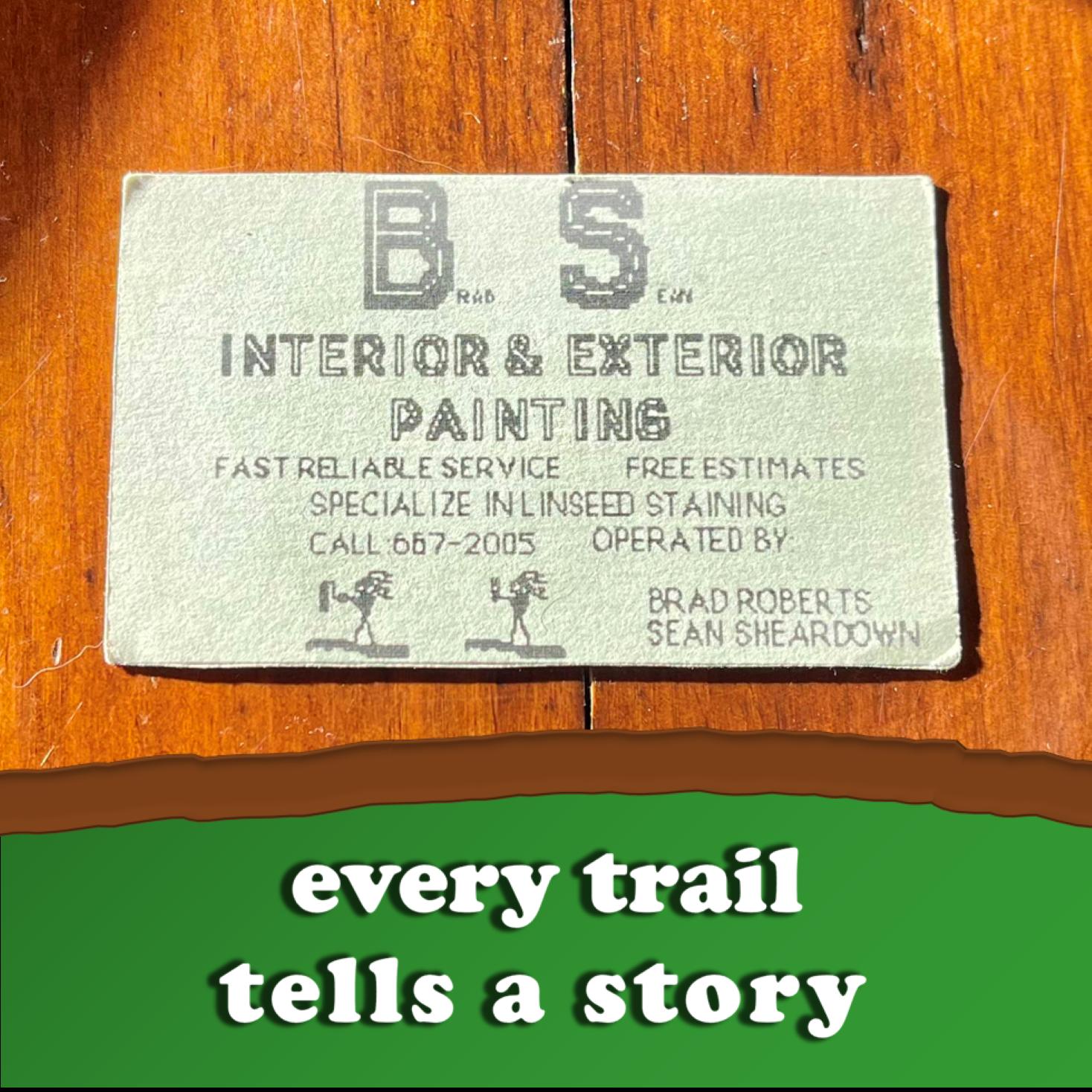
The origin of the BS name is that Brad and I had started an exterior painting and staining business and we'd occasionally do interior painting as well if somebody wasn't concerned about having the highest, highest quality, but getting a good price was more important to them. We're like 15 or 16, so that would have been. No, we must have been 16 because we could drive. So, 16 or 17…
[00:10:16] BRAD: You got to know a little bit of the history to know the play on words.
[00:10:20] SEAN: So, we called our painting business B and S—BS Painting. I keep on saying B and S because it's out there now. But it was BS Painting because we thought it was kind of cheeky to say BS.
[00:10:31] BRAD: The BS is like, of course, bullshit, tongue in cheek.
[00:10:34] SEAN: And it was Brad and Sean was the other part that tied into it.
[00:10:38] BRAD: And Sean still has the business card to it, yes.
[00:10:41] SEAN: It was the early days of computers and Brad's family had a Apple II, I think, or something like that. And so we did up this little pixel drawing of a crazy-looking guy running around with a roller and paintbrush in his hands. Linseed oil staining was kind of our specialty. And we’d drive around and look for ones that were obviously beaten, battered by the weather.
[00:11:02] BRAD: And then we'd leave cards and just write an estimate on it, what we'd do it for. And we actually ended up with quite a bit of work.
[00:11:10] SEAN: We had that history of that name and it was like easy, you know, an easy one to agree upon between the two of us. And again, we liked that BS has that sort of double entendre to it. Besides Brad and Sean.
[00:11:23] BRAD: Nice to have your name on something, kind of. You know, people screw up the naming of things all the time. It doesn't really bother me at all. I guess I'm not really a stickler.
[00:11:34] SEAN: I don't care that much about the actual name, to tell you the truth. I feel like it's almost a thing that people who know will know. And maybe it's nice to keep the other name because people who know it’s BS will know the reason behind it.
[00:11:49] BRAD: The BS was designed as a downhill, more downhill with features. Like, My Trail/Your Trail was a little bit going through the forest and I remember there being a lot of spiky trees at the beginning. But it, it's pretty close to the same time frame, though.
[00:12:08] SEAN: Mario had cracked open the door a little bit on the idea of building trails and we nudged it a little further. There was a flurry of building around that time because there was Sean McFarland's trail Doghouse. Paul Christensen did one and then Money Shot. And then, after that it, seemed to kind of take off. And you know, it's just been kind of a proliferation of trail building since then.
We were mostly just wanting to make something that was fun for us and was hopefully going to be fun for other people.
And you know, we didn't think much beyond that.
[00:12:39] BRAD: I think, as mountain bikers, you kind of look ahead a bit and walk it and as you're going, you're route finding and you're trying to find things that'll be fun to ride. A lot of that was, like, you're going to come out here and you're starting here. So, you don't know exactly where you're going to go, but you kind of want to gauge it to kind of. Is this going to be fun?
It's a lot of learning, too, because it was one of our first attempts at kind of creating a trail just for mountain biking. I know now when I do trails, I try to use my downslope a lot more. Like, B and S… a lot of it was freaking straight down. That's not how I do it anymore. I try to use the down terrain. You don't need such a steep kind of trail in order to have a lot of fun and kind of, you know, get your berms in and your turns and your whoop dee doos and stuff.
[00:13:28] SEAN: We had a general idea of where we wanted to start and where we wanted to end up. We knew there were big drops kind of from the start of where the Grey Mountain Road narrows down after the second lookout.
And it had sort of an easy way out because the Cantley Lake Trail was down below. So, the main criteria was just that it was going to be easy to get into and out of. And we knew there was a fair bit of drop involved between those two trails. The full trail, as we had in our minds, ended up being broken into kind of three parts.
I've heard some people used to, maybe they still do, call it 1, 2, 3. So the first part, like, yeah, probably took a day or two to get the line in. And that one was from the kind of second lookout on the Grey Mountain Road down to the Cantley Lake Road.
That road ended up being such a focal point for the mountain biking in Riverdale. You know, it was a huge asset.
And then the second part of the trail, we found a little gully that was running adjacent to the Cantley Lake Road. And we started from kind of the south end of the gully and tried to do kind of like, a bit like a pinball, like rocketing up and down the sides of the gully, and you came spitting out the bottom of that.
[00:14:37] BRAD: The gully was a nice feature to kind of utilize. It was definitely something that added a little spice to the ride.
[00:14:48] SEAN: And then there was a little steep section of trail and some tight wooded stuff that we ended up tying into so that you could drop back down to the Cantley Lake Trail and then ride back up to the road, so that you could kind of do a loop and you could doa few sessions in a day, if you wanted to.
[00:15:06] BRAD: We spent a lot of hours kind of going through the bush there. Quite a bit of exploring in that area.
[00:15:12] SEAN: As near as I can remember, we just went in and started picking a line and started building as we went. And I started almost, say, “building” in quotation marks there. Because it wasn't a whole lot of building. Like, I think maybe the first downhill, we might have used a shovel a little bit. To dig out some of the side hill and bank. To make it sort of flat and level.
[00:15:31] BRAD: What were we using? I would assume it would be just a regular shovel. But I don't remember a specific tool, per se.
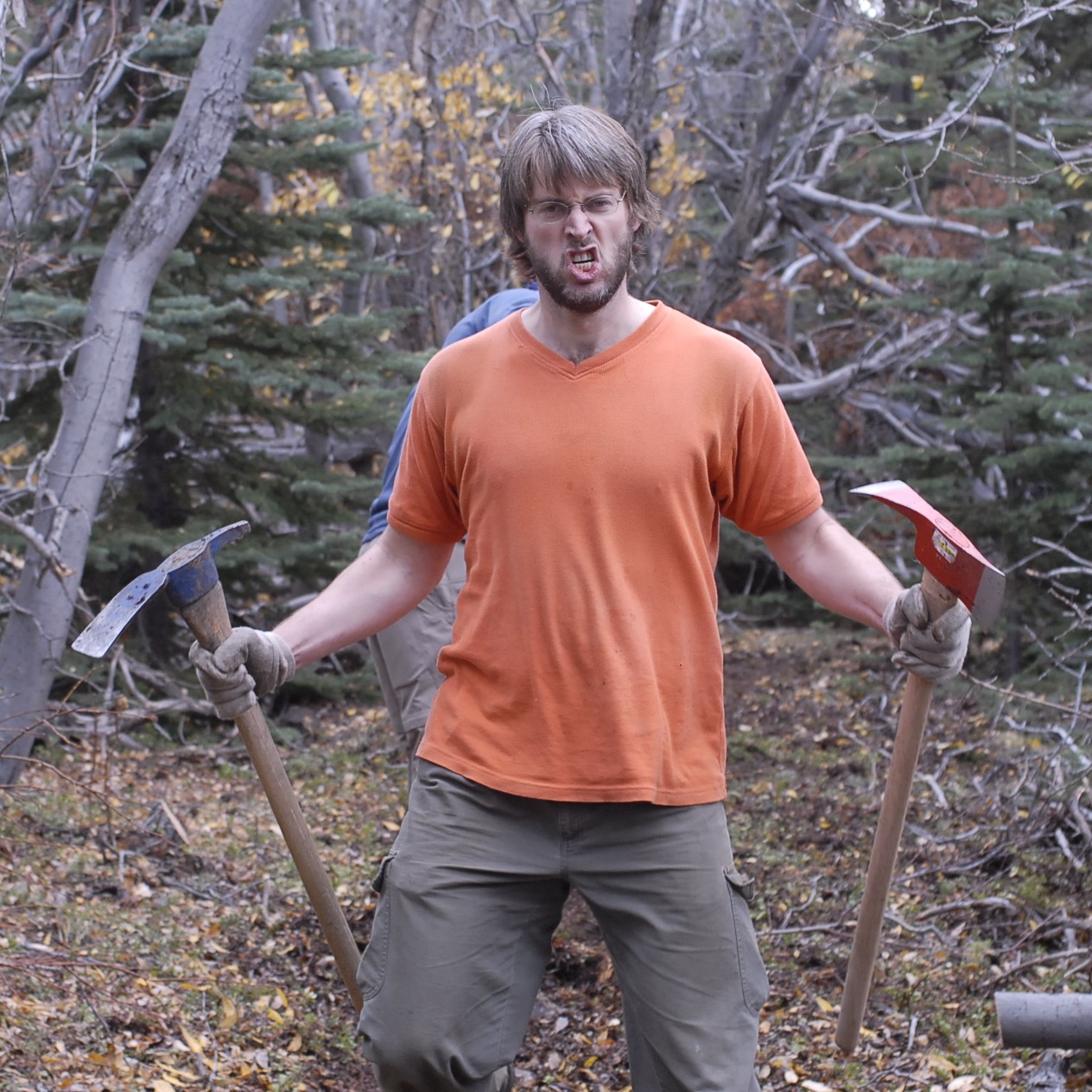
[00:15:40] SEAN: Our main trail building tool was just a big, heavy stick that you would use to walk through the woods and break branches off where you wanted to go. And you'd use a stick until it broke, and then you’d find a better stick. Like, often the stick you broke your stick on would become the stick that you'd use to keep on breaking stuff. Once you found a good stick, you held onto it because, yeah, a lot of the stuff up here ends up just turning to sort of puff and brittle, you know, with aging. And we just would leave the sticks out there and come back and find them the next day. And carry on from where we'd left off.
Somewhere towards the bottom of the first part of the trail, for the longest time, the stick I used to beat branches was still there. Like, I left it leaning up against a tree. It was some old thing that was age-hardened. And looked a bit like a shillelagh. I remember it had a little bit of curve at the end. And was probably inch and a half in diameter, maybe 2ft long, 3ft long. Had some pretty good heft to it. So, it could snap branches off. And I'd be curious to go back and see if it happens to still be there for any reason.
You'd kind of drag your feet to mark out a bit of a line on the forest floor of where you wanted to go. And then once you had a line roughed in enough that you could walk it easily, you'd go back and get your bikes and get your friends and start riding the trail to break it in.
There was our group of people that we rode with regularly. That we made a point of. Once it was completed, we go out and do rides. Like, sometimes, you know, like four or five sessions on the trail in a day. Or, you know, ride it as part of a loop into other trails.
It was myself and Brad and maybe four or five other people that we got out. Anna Pugh was one of the people we rode with a lot, too; I should mention that.
Word just spread kind of beyond that, like to other people. Just sort of spread naturally.
[00:17:24] BRAD: Part of it was that, and part of it was breaking it in with motorbikes. I know we used our mountain bikes—I mean, our motorbikes—quite a bit, to kind of bust them in back when, you know, you could drive out of Riverdale with a dirt bike and you wouldn't be chased.
[00:17:41] SEAN: I rode it a fair bit on the dirt bike and I think that's part of why it broke in so nicely, is you can have 100 mountain bikers go over a trail and it won't really, in my experience, change a whole lot. But you get the right type of dirt biker, and I say the right type because you got to go in there and ride aggressively, but not so aggressively that you're spinning out and busting berms. But if you ride just aggressive enough, you're going to be able to push dirt around a little bit to build up berms, dig in little, like grooves… If it's done properly, it can definitely enhance a trail.
I think towards the end with some of the skinny building, we had a little bit of help from like, Jason Howden and Anna Pugh came out and did some stuff and sort of some of the further stretches of the trail, like the second and third parts of it, people helped out a bit. But for sure, the first part of the trail was just Brad and I.
For probably the initial trail, like without the skinnies, I would guess maybe 40 hours to get it to 90% complete. The whole thing was done pretty quickly.
There wasn't anything that we were trying to keep hidden, like in any way from, you know, bikers or non bikers.
[00:18:53] BRAD: No, we weren't trying to hide anything. It wasn't ever like going to be like a secret trail only for the chosen. It was never that. It was just like, if you can find it and ride it, that's great.
[00:19:06] SEAN: We didn't go out and take out radio ads or anything saying that we were doing this, but we weren't trying to be secretive about it either because I think we felt in our hearts that we were building an asset to the community, not doing anything detrimental. But the approval or permits or anything kind of regulatory related to building a trail… we didn't even think of. We just went out and did it.
[00:19:26] BRAD: You just, just did it.
That was part of the beauty of the Yukon too. You just went out and did things. Some of that is still there where you go out and just do it. Because, ask permission... you might not get permission. Or, you might in five years.
[00:19:43] SEAN: Compared to some of the stuff that had been done around Whitehorse before, we were leaving a pretty small mark on the landscape. And the most aggressive thing we were doing was breaking mostly dead branches off of trees. So, we honestly didn't think anyone was going to get in a lather about it and, you know, felt like we were providing something that people were going to enjoy.
I think the first time that we brought chainsaw out there was when we actually started building skinnies. I don't think a single tree was cut out of the way to make that trail.
[00:20:12] BRAD: Cutting a few trees down isn't going to harm anything. There's so many trees up here.
[00:20:16] SEAN: We were winging it as far as it came to building the skinnies. As I think about it more, I seem to recall the first one was towards the lower end of the first section of the trail.And it was a flat log that, like it was a log that was laying already on the ground with a bit of a root thing you could approach on. So, we ended up just flattening it down a little bit. And it was kind of an easy one to get up on and to ride off. And it was just at ground level, so it was low consequence.
And then once we kind of seen how enjoyable that one was, then the second one we built was a little further up. And that was the real big, long one. It probably ended up being 100ft long at the end, I think, and got up at one point about 10ft off the forest floor.
That was a real North Shore inspired one. It sort of took elements of everything. Like there's some long skinnies. And then to get up to the highest point, there was kind of a ladder we made out of sticks going up both sides to get up to a top. You really wanted to make sure you had enough speed because there's big gaps between those sticks. So, you really wanted to make sure you didn't twist your wheel sideways when you're coming down it.
And then, we intentionally left it without an off-ramp. So, you had to do a wheelie drop. Because at the time the wheelie drop was a fairly advanced technique for us. And it was good to have something that you could kind of test yourself on. And that was all built with local materials.
[00:21:38] BRAD: We didn't have quads then or, you know, you're not going to hike a two by four down the mountain. So, it was just kind of using what's around you, trying to use the terrain for the most part.
[00:21:50] SEAN : Everything was built out there and there were nails that we brought with us, but all the wood we got from out there.
[00:21:55] BRAD: It was using the trees that were there, using the logs, cutting up others to kind of corduroy it.
[00:22:02] SEAN : We probably weren't cutting down green trees. I think we were just finding stuff that was already down. And I just had a little chainsaw at the time. And we started off trying to mill one of these trees flat. And if you've ever tried to cut vertically through a tree or a log, it does usually not go well unless you've got a great chainsaw.
So, we ended up discovering that if you made kind of crosshatch patterns all the way down the tree and then took a sledgehammer and a chisel to break out all the crosshatches you could eventually get to a flat surface. And it was actually kind of nice in a way, because with all the little sort of pieces and edges, it ended up giving you some pretty decent traction. Handy to have when you're up three or four feet off the ground.
[00:22:48] BRAD: I was also involved in that Trans Canada trail. I was hired on there with a chainsaw and I cut quite a bit of that behind Mount Mack there. A lot of that.
[00:22:59] SEAN: I remember running the saw a fair bit. Jason Howden did, I'm sure Brad did. We had bike shoes and bike shorts on. I can't remember if we took ear protection with us at the time. But you know, I wasn't real familiar with chainsaws. Jason knew a little bit more about them. No one got hurt doing any of it. So.
I would have for sure been the first test pilot all the time. I was, I think the most sort of daredevilish of the bunch in that way.
But everyone would eventually try it. And honestly, it's kind of fun to think back on of all the things that could have gone wrong, but I don't really remember anybody having any…. I remember people getting more hurt just on real fast sections of other trails and going down and banging into a tree or getting stuck, slammed to the ground pretty hard. But I don't remember anybody ever getting hurt on BS.
[00:23:53] BRAD: The features, I was okay at. Sean was always better at kind of navigating those things.
When I first began, I didn't always make everything. Sometimes, even if in your prime, you might not make some of those features we had, because they, you know, in our ignorance, too, we probably built some things that were a little on the extreme side, especially for the time.
The one that always comes back for me is the one—it kind of started off as the ground was going away from you, and you were kind of heading out on, like, a very long log. And then you had to turn to the right, and then you had to do another turn to the right, and then you went over a teeter totter. And it was a long ways up when you hit that teeter totter. So, yeah, you wanted to kind of make sure that you were on it.
And that was after the gully, after the compression. It was kind of down the gully a little ways. So, I thought it was around between 6 and 8ft. Like, it was high enough that I'm pretty sure that people had been hurt on that one falling off of it. It's not something I would build today for sure.
We were bulletproof back then, man.
[00:25:15] SEAN: So the teeter of the teeter totter was actually from the old interpretive sign for Otter Falls on the Aishihik Road… I was working for Yukon Energy, so that helps me place things. Actually, I was a summer student with Yukon Energy.
And, you know, I referenced earlier that I'm a Champagne and Aishihik member, too. So I remember whatever was on that sign at Otter Falls wasn't really flattering to the local First Nations, and it wasn't accurate any longer. And so I reported that back to Yukon Energy, and then they passed it along to the Yukon government tourism people. I can't remember who it was, but a lady with Yukon Tourism phoned me up and said, you know, just next time I'm up there, if I could help them out and take the sign. So, I just took a saw and took the sign down and loaded the back of a truck.
And one of the posts that was holding up the sign ended up being that teeter. So, we hauled that in to make the teeter on the teeter totter, the ramp or whatever you'd call it. Nobody liked that obstacle. Because I remember you had to kind of fly at it with some pretty good speed to be able to get up the whole way on it. And then you kind of had to slam on your brakes for like two seconds while you wait for your weight to make the teeter totter transition from up to down and then go off it.
[00:26:38] BRAD: All of them have been dismantled by now. They had to rip them apart physically. Even 20 years later, they stood the test of time.
[00:26:51] SEAN: For what I might have done differently. I remember, like, there was a whole different line I'd probably take now if I could have it to redo through that initial part where I just think it would be more flowy. You know, it's looking at it with different eyes and maybe different ideas of what makes a fun trail as well from the initial days.
Because I think part of that first drop was still a bit of a throwback to our old style of riding, where it was fun to have a hill that you had to get your butt over the seat and back of the seat and lock the rear brake up a little and skid down. If I had to do over again, I would definitely pick a different line off the top there.
The city ended up sort of taking ownership of a lot of these trails. They did some remediation work, which included replacing a lot of our original skinny structures to make safer ones and putting signage up. And interestingly, like, they contacted me because they knew that I built that trail. So, they wanted to ask if I had any input for rerouting it. And it's kind of funny just, you know, I talked about how we just, we picked a starting spot and we went and started building and didn't really look back. But then going back like 10 years after the original build to look at this possible reroute. I saw so much of the area in a different set of eyes. Like I wanted to radically reroute it, do a completely different line down there, just because I thought there's a lot more fun terrain that could be access adjacent to the trail, but not quite where the trail went.
But that wasn't within the scope of the City of Whitehorse’s project at the time. So even though I kind of had these ambitions to reroute the thing extensively, they just really wanted to redo the start.
[00:28:25] BRAD: B and S has definitely improved. What they've done has been great. It's a lot of fun.
[00:28:30] SEAN: It's nice if people make the effort when they're looking to readjust something or change something to find out the background of it and, you know, if the person's around who did it, maybe chat with them about it.
I didn't ask any permissions when I went in and built the trail. So, I wouldn't really expect that other people, if, you know, they've got a compelling reason to change or adjust something or alter it, to necessarily seek me out to get my approval either.
Enough people seem to know of Brad and mine's history with the trail that when there was work that was looking to be done, they'd come in and, at a minimum, let us know what was going on. I think when a lot of that stuff happened, I was maybe living out here in the Junction already, actually, so, you know, I wasn't going on the trail all that much, and it wasn't real easy for me to get in and do stuff.
And honestly, I'm impressed with how much the city has embraced the mountain biking. Back when it was feeling like it was just 10 or 12 of us riding around, we were always like, “Oh, wouldn't it be great if there was, like, more involvement on the trails and more people to go out with?” And we had never have imagined that it would take off and become as popular as it has now.
[00:29:38] BRAD: It's great that they're making the efforts, but I think more can be done. We need to get the machines out there and really do it. There is too much traffic to not do something. Otherwise, you have to continuously go back and fill in between the roots and that sort of thing.
So, I still make trails. I make trails every year. I live out near… kind of towards Marsh Lake now, and I do logging and firewood. In order to get firewood in the Yukon, you've got to make trails. And while I'm making those trails, I kind of design them so I can bike them and ski them. And some of the trails behind my house are some of my favorite trails.
Well, if you ever see me on the street, you can ask me and come on out and I'll take you for a spin.
[00:30:29] SEAN: It was, at the time, it was a pretty unique trail in the kind of the whole inventory of Whitehorse trails.
Probably my favorite part of it, after we were done, had to be that sort of long, high, skinny in the middle. Just because… you never took it for granted that you were going to make the whole thing. It was always a challenge, and at the time, there was nothing even comparable to it that I knew of in Whitehorse.
[00:30:55] BRAD: I try to get out and mountain bike usually a couple times a week when it's good. I find when I'm riding, it's usually I'm paying attention to where I'm going. So, I'm not necessarily reminiscing, just trying to live in the moment. And I'm not necessarily thinking of the past. That's part of the beauty of mountain biking is that you gotta be in the moment.
So I can't say it brings back memories as I'm riding.
[00:31:24] SEAN: I mean, I got lots of little memories, but there's nothing stands out into like, wow, was that funny, or was that a close call? Or that was scary, or anything like that. Like, it was like, good memories out there with friends doing stuff. And who would know that, yeah, we'd be here like 20 or 25 years later talking about it.
I walk it sometimes now, too, just because we got dogs and go out there with my wife if we're in town, and we'll go down walking on it just to kind of see how it looks and how things have evolved. And I've seen the increase in mountain bikers and ran into people that I don't know.
I remember in the younger days, when we first started into it, if you were out on a trail between the tire track and the size the dog paw prints on the trail in front of you, you knew who had been riding it last before you did. And I think those days are kind of long gone in Whitehorse now.
[00:32:16] BRAD: I enjoy the flow trails. I will get some air, but I'm not hucking off things anymore. After 50, the landings are… Sometimes it takes a lot longer to recover. You know, I was never the big risk taker. Even though you look back at the BS trail and we had that crazy one that kind of went up in the air, then we had a teeter totter at the end… I did ride it, but, you know, that gets the heart going. So, I don't really do the big whoops anymore but… You have to get in the right frame of mind.
[00:32:59] SEAN: You know, I could be wrong on all this. It's a long time ago and obviously wasn't thinking too much about trying to remember it for posterity.
[00:33:13] HOST: Every Trail Tells a Story is made by Talking Mouths. Theme music is Blue Ska by Kevin McLeod. Other music is from Blue Dot Sessions. You can find detailed episode credits and transcripts at talkingmouths.com. Thanks to builders Brad Roberts and Sean Sheardown, and to rider Tyler Coghill. Thanks for listening.
[00:33:49] SEAN: I could take a look after we're done here to see if I have one of those cards. It'd be kind of cool if I did.
Dogs barking
Hey. Okay, that's enough. Lay down. I guess we'll edit that out? I could probably start that better, too. Yeah.
[00:34:04] HOST: Okay. I always find a way to use outtakes, too.
[00:34:05] SEAN: Yeah. Yeah.
Well, everyone knows that there's a strong connection between mountain biking and dogs.